Build to rent · Developers · Property management · Mixed use
Amenity that actually lives.
A vertical herb garden for the whole building. Fresh herbs and leaves for residents through the year, in the lobby, the lounge or the terrace, looked after entirely by us.
The opportunity
Most amenity photographs well, then does nothing.
Residential buildings compete on amenity, and a great deal of that amenity sits still. It looks excellent in the brochure and gets used twice. A living herb garden behaves differently, because it changes, it produces something, and it asks to be visited.
Residents pick, taste and gather around something genuinely alive. It gives them a daily reason to pause in a shared space, and a natural, low stakes way to speak to a neighbour, which is the thing every building says it wants and very few actually engineer.
It is not decoration. It is a productive centrepiece that gives a lobby, a lounge or a terrace an obvious purpose.
The Harvestory insight
Community is the biggest driver of renewals.
Buildings do not lose residents over the specification of the gym. They lose them because nobody knew anyone. A shared harvest, a seasonal moment and a reason to stop in the lobby are cheap ways to turn residents into neighbours, and neighbours renew.
Why it earns its place
More than a growing system.
Resident wellbeing
Nature, calm and fresh food woven into the walk through the front door. A wellbeing amenity residents use rather than walk past.
Differentiation
A living amenity a competing building cannot copy overnight, and a memorable story for lettings, launches and tours.
Community and retention
Shared harvests and seasonal moments give residents a reason to speak to each other, which is what actually drives renewals.
A marketing asset
Instantly understandable in photography and on tours. It is the kind of thing residents photograph and share, which does your marketing for you.
Sustainability credentials
Visible, zero distance food production that strengthens a building's sustainability story and contributes to green building credentials.
Nothing for your team
Installed, maintained, harvested and replanted by us. No horticultural knowledge required from the building team and no new responsibility on the rota.
In your space
Even where there is no daylight.
Lobbies, lounges and communal kitchens are frequently the darkest spaces in a building, which is exactly why they end up with plastic planting or nothing at all. Our systems bring their own light, so they work in the overlooked corners and make parts of the building earn their keep.
Plants are rotated with the seasons and the signage is refreshed with them, so the display stays alive and worth stopping for rather than becoming part of the wallpaper.
Every installation is designed around the space, the people who will use it and the story worth telling there. Start with one, then expand what works.
Indoor · Cabinet
GrowStation
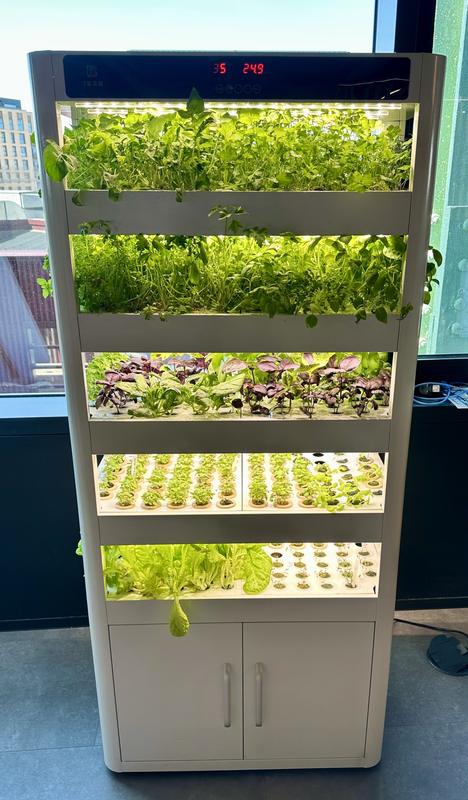
A cabinet system with real visual weight and a clear growing structure. Herbs, salads and edible leaves at eye level. It suits canteens, offices, receptions and classrooms, and works well as a first installation.
Indoor · Everyday herbs
Herb Station
An assortment of culinary herbs for everyday use, grown together in one cabinet. Basil, coriander, mint, parsley and chives, cut and come again, so you take what you need and the plant keeps producing. The most practical starting point for a kitchen or a communal space.
Immersive · Flagship
Living Wall
A larger, immersive feature for arrival spaces, dining rooms and flagship sites. High visual presence and a strong signal about how a place thinks about food.
Indoor or outdoor
Totem
A vertical growing tower with a small footprint and a big presence. Good on terraces, in lounges and at events, and striking when several are grouped into an indoor market garden.
Seed to stomach
On site nursery
A propagation area so a site can grow from seed and see the whole journey. This is where the story becomes complete, and where deeper engagement and long term ownership come from.
Bringing it to life
An installation is the excuse. The gathering is the point.
These sessions are drawn from workshops we have already run. Pick one to launch with, or rotate them through the seasons. Every one is built to teach, connect and celebrate.
Smoothie Sensation
Greens and herbs cut on site and blended fresh. A natural fit for wellbeing weeks, sports teams and recovery.
Drinks Discovery
An evening drinks session where the garnish and the herbs lift something simple into something memorable.
Tea Workshop
Herbal teas brewed from leaves cut that morning, paired with mint madeleines. The calmest of the five.
Pesto and Pizza Party
Pesto made together from basil cut minutes earlier. Easy, popular, and usually the one people ask to repeat.
Root Ritual
Germination and propagation, hands in the growing medium. A grounding introduction to growing from seed.
Common questions
The things people ask first.
What is a living herb garden in a residential building?
It is a growing installation in a shared space, usually a lobby, resident lounge or terrace, that produces fresh herbs and salad leaves for residents through the year. Harvestory installs it, maintains it, harvests it and replants it, so nothing falls to the building team.
What does the building team have to do?
Nothing. This is a fully managed amenity. Harvestory installs, cares for, harvests and replants it, and no horticultural knowledge is needed from anybody on site. Resident workshops and harvest events are available as an option where a building wants them.
Will it work in a lobby with no natural light?
Yes. The systems carry their own lighting, which is why they suit lobbies, lounges and communal kitchens that are often the darkest spaces in a building. Those overlooked corners are frequently where an installation has the most effect.
How does it help lettings and retention?
It gives a building an amenity that changes, produces something and asks to be visited, which is rare. It photographs well for lettings and launches, and shared harvests give residents a low stakes reason to speak to each other. Community is consistently the strongest driver of renewals.
Can residents take the herbs?
Yes. Residents pick what they need, which is the whole idea. Crops are cut and come again, meaning the plant keeps producing after each harvest, and plants are rotated with the seasons so the display stays worth stopping for.
Get in touch
Let's plan your first building.
Tell us about the scheme, the space you have in mind and how it is managed. We will tell you what would work in it and what a first installation looks like.