Primary · Secondary · SEN · Further and higher education
Food literacy taught by growing it.
A growing system in a school is a science lesson, a food lesson, a maths lesson and a sustainability lesson that happens to also produce lunch. Children remember what they planted.
The opportunity
The lesson that keeps running after the bell.
Most sustainability teaching in schools is about somewhere else. Rainforests, ice sheets, supply chains, all of it real and none of it in the room. A growing system is the version that is in the room, changing daily, and dependent on the class remembering to look after it.
It maps onto the curriculum without much effort. Germination, plant biology, the water cycle and measurement in science. Growth rates, yields and record keeping in maths. Food, nutrition and preparation in design and technology. Systems, resources and sustainability across the rest.
And it works especially well in SEN settings, where a repeatable, sensory, low pressure task with a visible outcome is exactly what is wanted.
The Harvestory insight
Children remember what they planted.
A pupil who sowed a seed in September and ate the salad in October understands something about food that no worksheet delivers. It is also the rare school activity that a child will describe to a parent unprompted.
Why it earns its place
More than a growing system.
Curriculum links
Science, maths, design and technology, food and nutrition, and personal development all have a natural way in. The installation is a shared resource rather than a single subject's kit.
Food and nutrition
Pupils grow, harvest and eat. Tasting something you grew is the most effective argument for vegetables anyone has yet found.
Enrichment and clubs
A ready made growing club, an eco committee project and something concrete for pupil leadership groups to own and report on.
SEN and wellbeing
Sensory, repeatable and gentle. Sowing, watering and harvesting offer structure and a visible result, with no wrong answers to get wrong.
Whole school visibility
Parents at pick up, governors on a walk round and inspectors all see it. It makes a school's values legible in about four seconds.
Catering and waste
Herbs and leaves into the school kitchen, and a practical, visible conversation about food waste and food miles that starts on site.
In your space
Start at the seed.
A nursery is where the education really lands. Propagation is fast, visible and forgiving, and it means a school is not just maintaining a system somebody else planted. Pupils see the whole journey from a seed in a tray to a leaf on a plate.
It also makes the programme self sustaining. A school growing its own seedlings has a rolling activity every few weeks rather than a single planting day in September.
Every installation is designed around the space, the people who will use it and the story worth telling there. Start with one, then expand what works.
Indoor · Cabinet
GrowStation
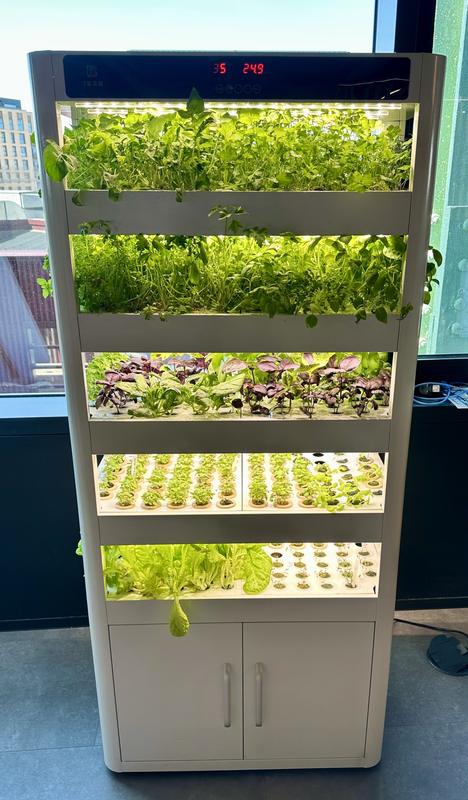
A cabinet system with real visual weight and a clear growing structure. Herbs, salads and edible leaves at eye level. It suits canteens, offices, receptions and classrooms, and works well as a first installation.
Indoor · Everyday herbs
Herb Station
An assortment of culinary herbs for everyday use, grown together in one cabinet. Basil, coriander, mint, parsley and chives, cut and come again, so you take what you need and the plant keeps producing. The most practical starting point for a kitchen or a communal space.
Immersive · Flagship
Living Wall
A larger, immersive feature for arrival spaces, dining rooms and flagship sites. High visual presence and a strong signal about how a place thinks about food.
Indoor or outdoor
Totem
A vertical growing tower with a small footprint and a big presence. Good on terraces, in lounges and at events, and striking when several are grouped into an indoor market garden.
Seed to stomach
On site nursery
A propagation area so a site can grow from seed and see the whole journey. This is where the story becomes complete, and where deeper engagement and long term ownership come from.
Bringing it to life
An installation is the excuse. The gathering is the point.
These sessions are drawn from workshops we have already run. Pick one to launch with, or rotate them through the seasons. Every one is built to teach, connect and celebrate.
Smoothie Sensation
Greens and herbs cut on site and blended fresh. A natural fit for wellbeing weeks, sports teams and recovery.
Drinks Discovery
An evening drinks session where the garnish and the herbs lift something simple into something memorable.
Tea Workshop
Herbal teas brewed from leaves cut that morning, paired with mint madeleines. The calmest of the five.
Pesto and Pizza Party
Pesto made together from basil cut minutes earlier. Easy, popular, and usually the one people ask to repeat.
Root Ritual
Germination and propagation, hands in the growing medium. A grounding introduction to growing from seed.
Common questions
The things people ask first.
How does a growing system fit the curriculum?
It maps onto several subjects at once. Germination, plant biology, the water cycle and measurement in science. Growth rates, yields and record keeping in maths. Food, nutrition and preparation in design and technology. Sustainability and resources across the rest. It is a shared resource rather than one subject's equipment.
Is it suitable for SEN settings?
It works particularly well in them. Sowing, watering and harvesting are sensory, repeatable and low pressure, with a visible result and no wrong answers to get wrong. Many SEN settings use it as a structured activity rather than a curriculum resource.
How much staff time does it take?
A few minutes a day and a longer task once a week, and Harvestory is specific about this before a school commits, because staff time is what makes or breaks it. Where a school runs a growing club or an eco committee, pupils take on most of the routine.
Can pupils eat what they grow?
Yes, that is the point of it. Harvestory maintains written food safety and allergen procedures, and produce can go to pupils directly or into the school kitchen. Tasting something you grew yourself is the most effective argument for vegetables anyone has found.
What is a nursery and why does it matter in a school?
A nursery is a propagation area where seeds are germinated before being moved into a growing system. It matters in a school because it makes the programme self sustaining and gives pupils the full journey from seed to plate, rather than maintaining something an adult planted.
Get in touch
Let's talk about the year ahead.
Tell us about the school, the age range and whether this is curriculum, enrichment, catering or all three. We will be realistic about staff time, because that is what makes or breaks it.