A single installation in the right space will tell you more than any proposal. Here is how we get from a conversation to something growing, and what happens after that.
Before anything is installed
We would rather talk you out of the wrong space.
The difference between an installation that becomes part of a building and one that quietly gets ignored is almost never the equipment. It is where it went, who was around it, and whether anyone was ever properly introduced to it.
So the first conversation is about the space and the people, not the specification. If the honest answer is that a particular lobby or canteen is the wrong place, we would far rather say so at that point than six months later.
The short version
Start with one. Expand what works.
One installation, in the right space, with a proper launch. It gives a leadership team something real to look at, builds the internal case far better than a business case does, and tells you what the next one should be.
The programmes that end up across floors, sites or a portfolio almost all started with a single unit somebody was slightly unsure about.
The five steps
Plan. Install. Activate. Support. Review.
01
Plan
We start with the space rather than the system. Where do people already stop, and where do they only pass through? What is the light, the water, the access and the floor loading? Who will be around it every day, and what would you actually want them to get out of it? This is also where we are honest if somewhere is the wrong place for one.
02
Install
We deliver, build and hand over. The growing starts before the installation arrives, in our nursery, so the space is green and productive from the first day rather than looking like an empty rack for three weeks. Handover comes with the guidance, the routines and the record sheets, not just the keys.
03
Activate
An installation that is never introduced becomes furniture within a fortnight. So we launch it properly, with a harvest, a tasting or a workshop, and give people a first experience of it rather than leaving them to work out what it is. This is the step that decides whether the whole thing gets used.
04
Support
Regular visits to top up, check, replant and keep the crop rotation moving, plus a hand on the tiller for whoever has taken it on internally. Enough contact to keep momentum and to catch problems early, without making the space dependent on us being in the room.
05
Review
We look at what grew well, what got used, what people responded to and what the space told us it wanted. Then we plan the next season around that, and decide together whether it is time to expand to another floor, another space or another site.
The formats
Choose the right anchor.
Every installation is designed around the space, the people who will use it and the story worth telling there. Start with one, then expand what works.
Indoor · Cabinet
GrowStation
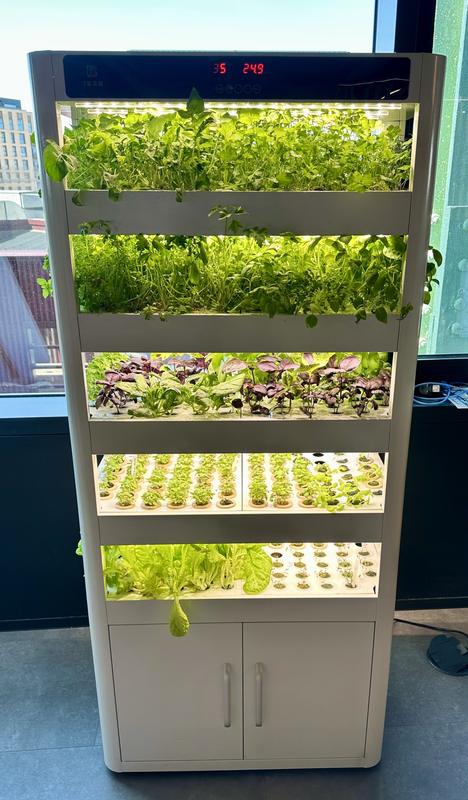
A cabinet system with real visual weight and a clear growing structure. Herbs, salads and edible leaves at eye level. It suits canteens, offices, receptions and classrooms, and works well as a first installation.
Indoor · Everyday herbs
Herb Station
An assortment of culinary herbs for everyday use, grown together in one cabinet. Basil, coriander, mint, parsley and chives, cut and come again, so you take what you need and the plant keeps producing. The most practical starting point for a kitchen or a communal space.
Immersive · Flagship
Living Wall
A larger, immersive feature for arrival spaces, dining rooms and flagship sites. High visual presence and a strong signal about how a place thinks about food.
Indoor or outdoor
Totem
A vertical growing tower with a small footprint and a big presence. Good on terraces, in lounges and at events, and striking when several are grouped into an indoor market garden.
Seed to stomach
On site nursery
A propagation area so a site can grow from seed and see the whole journey. This is where the story becomes complete, and where deeper engagement and long term ownership come from.
Common questions
The things people ask first.
What does a growing installation need to run?
Power, a small amount of floor or wall space and access to water. Most installations are not plumbed in, so water is carried to them. Floor loading, light and access are all checked during planning, before anything is ordered, so there are no surprises at delivery.
How much time does it take to look after?
Less than most people expect. A short daily check, a slightly longer task once a week and a reset once a month. All of it is written down and handed over at installation, and Harvestory is specific about the time before a site commits, because underestimating it is the most common way these things fail.
What grows in a Harvestory system?
Herbs, salad leaves, microgreens and edible flowers. Basil, coriander, mint, parsley, chives, dill, rocket, lettuce, pak choi, chard, kale, pea shoots and mustard all grow well. Varieties are chosen around the space, the season and what the kitchen or the people in the building will actually use.
Who looks after it, Harvestory or our team?
Either, and it is one of the first things agreed. Some sites want Harvestory in regularly with very little falling to their own people. Others want their team running it day to day with Harvestory behind them. The training and the written procedures are the same in both cases.
Is produce grown on site food safe?
Yes, and it is documented rather than asserted. Harvestory maintains written food safety, allergen, water management, cleaning, pest management and risk assessment procedures, each with record sheets, so an installation sits inside an existing food safety management system rather than beside it.
What does cut and come again mean?
It means the plant keeps producing after it is harvested. Rather than pulling a whole lettuce, the outer leaves are cut and the plant regrows from the centre. It is why a small installation can supply a kitchen or a floor of people continuously instead of in one go.
What is hydroponic growing?
Growing plants in water and nutrients rather than soil, with the roots supported by an inert medium. It uses far less water than growing in soil, has no soil to bring pests indoors, and gives fast, predictable growth, which is what makes it workable inside a building.
How long before there is anything to harvest?
The growing starts in the nursery before the installation is delivered, so a site is green from the first day. Microgreens are ready within two weeks, salad leaves within four to six, and herbs settle into continuous cutting after about six weeks.
Bringing it to life
An installation is the excuse. The gathering is the point.
These sessions are drawn from workshops we have already run. Pick one to launch with, or rotate them through the seasons. Every one is built to teach, connect and celebrate.
Smoothie Sensation
Greens and herbs cut on site and blended fresh. A natural fit for wellbeing weeks, sports teams and recovery.
Drinks Discovery
An evening drinks session where the garnish and the herbs lift something simple into something memorable.
Tea Workshop
Herbal teas brewed from leaves cut that morning, paired with mint madeleines. The calmest of the five.
Pesto and Pizza Party
Pesto made together from basil cut minutes earlier. Easy, popular, and usually the one people ask to repeat.
Root Ritual
Germination and propagation, hands in the growing medium. A grounding introduction to growing from seed.
Get in touch
Let's have the first conversation.
No specification needed. Tell us about the building and the people in it, and we will tell you whether there is something worth doing.