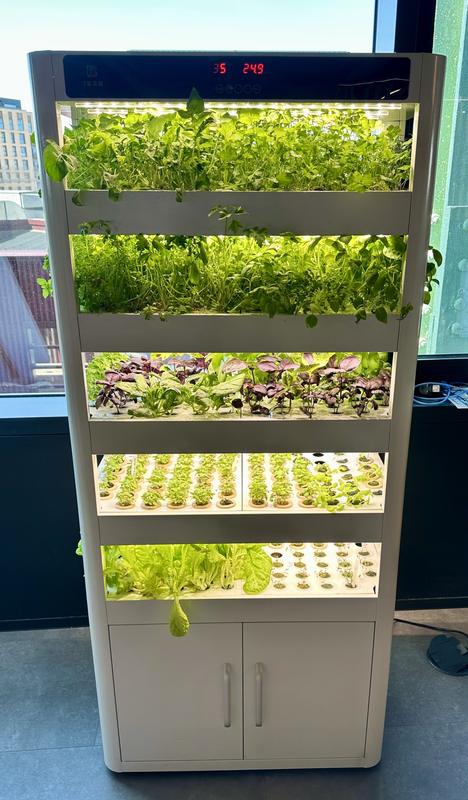
A reason to come in, and something to gather around when people do.
Fresh herbs and leaves growing in the middle of the working day. It gives a workplace a living centre of gravity, and gives people something to talk about that is not work.
The opportunity
Wellbeing you can see, not just report on.
Offices compete now on how they feel. Organisations spend heavily on sustainability commitments, wellbeing programmes and workplace experience, and most of it stays invisible. It lives in a policy document, a dashboard or a poster by the lift.
A growing installation is the opposite. It is immediately understandable. People walk past it, stop, ask what it is, and come back a week later to see what has changed. It turns an abstract commitment into something happening in the room.
It is also a reason to be in the building. When the question is why anyone should come in rather than dial in, a living, productive thing that only exists on site is a surprisingly good answer.
The Harvestory insight
Not decoration. Not a gadget.
Office plants are decoration. A one off workshop is an event. This is neither. It is a visible growing programme that becomes part of the rhythm of the place, week after week, and keeps giving people a small reason to interact with each other.
Why it earns its place
More than a growing system.
Workplace wellbeing
A calm, purposeful point of interaction in the working day. Real plants bring the biophilic benefits people already know about, focus, mood, air and energy, and they bring them somewhere people actually go.
Visible sustainability
Zero distance production, in the building, in front of everyone. It strengthens ESG and CSR reporting because there is participation and harvest data behind it, not just intent.
Talent and retention
A distinctive reason to be on site and a culture people describe to other people. It shows up in tours, in interviews and in the reasons people give for staying.
Client and visitor experience
A living installation signals your values before anyone says a word. It strengthens tours, bids and pitches, and it makes a space feel considered rather than fitted out.
Food literacy
People start to understand food again. Where it comes from, how long it takes, why freshness is not a marketing word, and how small habits change how they eat.
Community and culture
A shared object inside a building creates rituals and small responsibilities. People who would not otherwise speak end up talking over a tray of basil.
In your space
Signage does the quiet work.
The installation gets attention. The signage is what turns attention into understanding. It explains what is growing, how far along it is, what to do with it and why any of it matters, so people learn something on the way past rather than only when there is a session on.
It is refreshed as the crops change, which is also what keeps people looking. A display that is different this week is a display people check.
Every installation is designed around the space, the people who will use it and the story worth telling there. Start with one, then expand what works.
Indoor · Cabinet
GrowStation
A cabinet system with real visual weight and a clear growing structure. Herbs, salads and edible leaves at eye level. It suits canteens, offices, receptions and classrooms, and works well as a first installation.
Indoor · Everyday herbs
Herb Station
An assortment of culinary herbs for everyday use, grown together in one cabinet. Basil, coriander, mint, parsley and chives, cut and come again, so you take what you need and the plant keeps producing. The most practical starting point for a kitchen or a communal space.
Immersive · Flagship
Living Wall
A larger, immersive feature for arrival spaces, dining rooms and flagship sites. High visual presence and a strong signal about how a place thinks about food.
Indoor or outdoor
Totem
A vertical growing tower with a small footprint and a big presence. Good on terraces, in lounges and at events, and striking when several are grouped into an indoor market garden.
Seed to stomach
On site nursery
A propagation area so a site can grow from seed and see the whole journey. This is where the story becomes complete, and where deeper engagement and long term ownership come from.
Bringing it to life
An installation is the excuse. The gathering is the point.
These sessions are drawn from workshops we have already run. Pick one to launch with, or rotate them through the seasons. Every one is built to teach, connect and celebrate.
Smoothie Sensation
Greens and herbs cut on site and blended fresh. A natural fit for wellbeing weeks, sports teams and recovery.
Drinks Discovery
An evening drinks session where the garnish and the herbs lift something simple into something memorable.
Tea Workshop
Herbal teas brewed from leaves cut that morning, paired with mint madeleines. The calmest of the five.
Pesto and Pizza Party
Pesto made together from basil cut minutes earlier. Easy, popular, and usually the one people ask to repeat.
Root Ritual
Germination and propagation, hands in the growing medium. A grounding introduction to growing from seed.
Common questions
The things people ask first.
How does a growing installation help an office?
It gives people a living, changing thing to gather around in the working day. Staff cut herbs and leaves for lunch, notice the crop changing week to week, and start conversations with colleagues they would not otherwise speak to. It also makes a sustainability or wellbeing commitment visible in the building rather than only in a report.
How much space does an office installation need?
A cabinet system needs roughly one square metre of floor and a standard power socket. A tower needs less. Water is carried to it rather than plumbed in for most installations. Harvestory checks floor loading, access and light as part of planning before anything is ordered.
Who looks after it day to day?
Whoever the office nominates, and they are trained for it. The tasks are short, written down and easy to hand over when somebody leaves. Harvestory visits regularly to replant, check the system and keep the crop rotation moving.
Does it count towards ESG or BREEAM reporting?
It contributes. On site production removes food miles entirely for what it grows, and the programme generates participation and harvest figures that can be reported rather than estimated. It is evidence of a commitment being acted on, which is usually the harder part to show.
Can we start with one and expand later?
Yes, and that is the recommended route. One installation in the right space tells a leadership team more than a business case does. Floors, buildings and wider portfolios are added once the first one has proved where it gets used.
Get in touch
Let's find the right floor to start on.
Tell us about the office, the number of people in it and what you are trying to shift. We will tell you where an installation would actually get used, and what a first one looks like.